


19 Jan What taxes will self-employed individuals pay in 2026 – Detailed overview of the minimum imputed income
What taxes will self-employed individuals pay in 2026 – Detailed overview of the minimum imputed income
As the new 2026 tax year begins, self-employed professionals and business owners must familiarize themselves with the updated taxation system for business income. Income tax declarations are expected to open in a few months, and it’s important to understand both the changes in tax rates and the new provisions impacting professional income, as introduced by Law No. 5246/11-11-2025.
New Tax Brackets for 2026
Based on the new law, business profits—combined with any salary or pension income—are taxed according to new tax brackets, which now vary by age and number of children.
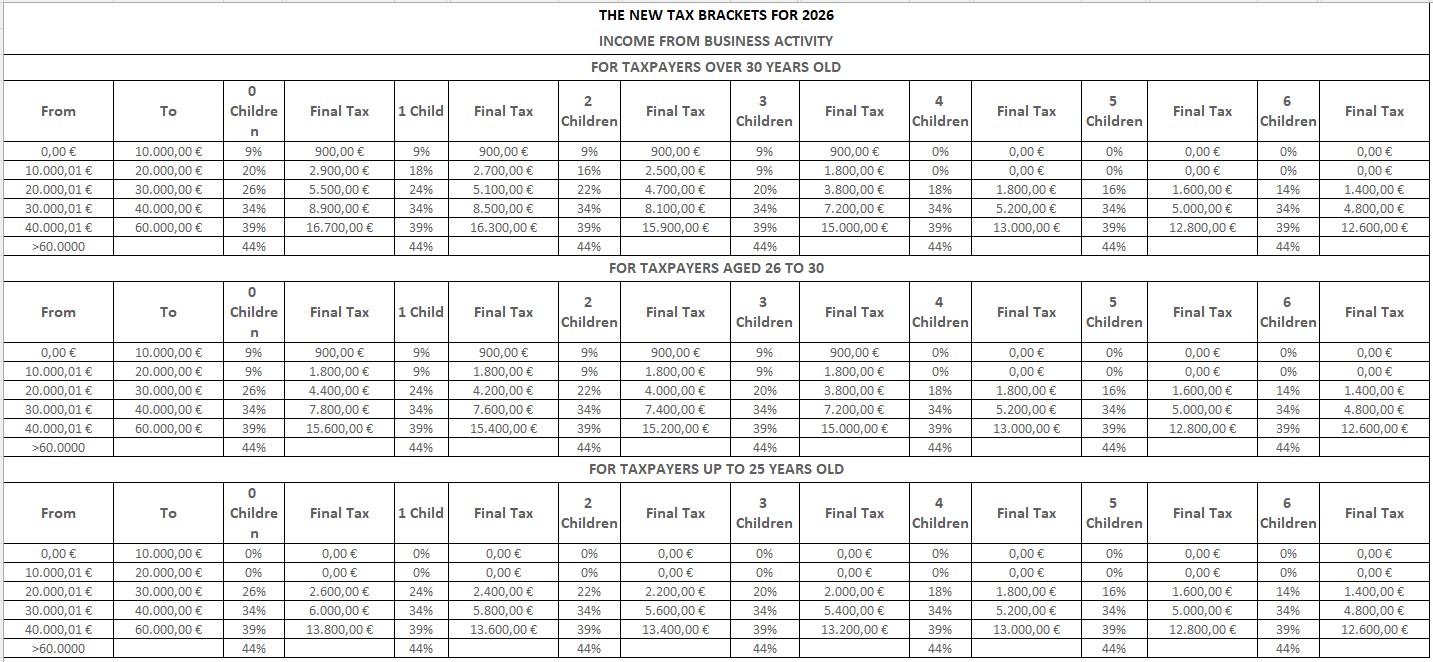
It is important to note that income tax reductions available for salaried employees and pensioners do not apply to business income, with the exception of income from agricultural activity.
The Minimum Imputed Net Income
One of the most significant changes in recent years is the introduction of a Minimum Imputed Net Income for freelancers and sole proprietorships. This sets a minimum profit threshold that tax authorities assume a professional earns from their activity and serves as the basis for tax calculations when declared profits fall below this amount.
In 2026, tax liability will no longer be based solely on reported profits (i.e., income minus expenses) but also on a new system that uses the minimum wage, years of operation, payroll costs, and sector turnover averages.
The formula for calculating the minimum imputed income takes into account:
- The current minimum private-sector wage
- Years of business activity (every three years)
- The total payroll cost, if there are employees
- The annual turnover, compared to the average turnover for the specific business sector (based on industry codes – ΚΑΔ)
Each year, the average turnover for each sector is published. These averages do not include sectors with fewer than 30 active businesses or those related to agriculture.
View the average turnover of sole proprietorships by business activity code (KAD) for the 2025 tax year in the PDF available here.
Exceptions – When the Minimum Income Does Not Apply
The law allows certain exemptions:
- Agricultural business income
- Professionals with up to 3 contracts (or up to 2 in the case of insurance intermediaries), working from home
- Individuals with a disability of 80% or more
- Cafés in villages with fewer than 500 inhabitants
- Small press distribution agents with up to 3 contracts
- Lottery ticket vendors
- Mothers in the year of childbirth, adoption, or foster care, and for the two years following
Grounds for Contesting the Imputed Income
A taxpayer may request a reduction if one of the following applies, supported by relevant documentation:
- Military service
- Imprisonment
- Hospitalization
- Inability to work due to pregnancy
- Natural disasters that partially or fully prevented business operations
- Revocation of operating license or professional license
- Government-mandated business closure (e.g., public health)
- Other force majeure reasons
Reductions in the Minimum Imputed Income
The minimum imputed income can be reduced in the following cases:
- If the professional also earns income from employment, pension, or agriculture, the imputed amount is reduced accordingly
- For new businesses, no imputed income is applied for the first 3 years. In the 4th year, it’s reduced by 2/3, and in the 5th year, by 1/3
- It is reduced by 50% for:
- Families with 3 or more children
- Individuals with a disability of 67% or more
- Single parents with underage children or children with a disability of at least 67% provided they are unmarried, divorced, or widowed and considered dependents
- Taxi owners with less than 25% vehicle ownership, and school canteen operators
- Also reduced by 50% for businesses based in:
-Communities or villages with fewer than 500 residents
-Villages with 500–1,500 residents excluding those located in the Region of Attica (with the exception of the Regional Unit of Islands) and specifically for the Region of Western Macedonia, the Regional Unit of Evros, and the municipalities of the Regions of Central Macedonia, Eastern Macedonia and Thrace, and Epirus that border the country’s frontiers, in municipal communities or settlements with a population between five hundred (500) and one thousand seven hundred (1,700) inhabitants
-Islands with fewer than 3,100 residents
The 2026 tax year marks a significant shift in how sole proprietorships are taxed. The increase in the minimum wage has pushed the imputed income up to €12,320, while new tax brackets and lower rates are also being introduced. The success of any business in this new environment will depend heavily on timely tax planning and full utilization of the exemptions and reductions provided by Law 5246/2025.
